What Can You Eat With Braces in 2026? Food Guide by Dr. Freeman
If you are asking, what can you eat with braces, you are not alone. It is one of the most searched orthodontic questions online, including variations like what can you not eat with braces and what foods can you not eat with braces
Patients and parents want clear, practical answers for what to eat with braces that they can use immediately.
This printable guide is written and reviewed by a Board Certified orthodontist and reflects current clinical standards supported by the American Board of Orthodontics and the American Association of Orthodontists.
Why Food Matters With Braces
Braces work by applying continuous, gentle pressure to move teeth through bone. The brackets and wires are precise medical appliances. Hard, sticky, or tear type foods can bend wires or pop brackets off teeth, which can delay treatment.
According to the American Dental Association, limiting sticky and hard foods reduces appliance breakage and lowers the risk of enamel damage during orthodontic treatment. Research published in peer reviewed orthodontic literature consistently shows that poor diet combined with inadequate hygiene increases the risk of white spot lesions around brackets.
Food choices affect three key factors. The first is mechanical safety. The second is enamel health. The third is patient comfort, especially during the first week after adjustments.
Understanding these principles helps families make smart grocery decisions instead of memorizing a random list.
Key Factors To Consider Before Choosing Foods
Before we break down what you can eat and what you cannot eat, here are the clinical rules I teach patients at Freeman Orthodontics.
If a food requires you to bite and tear aggressively with your front teeth, it is usually not ideal. If a food is extremely sticky and clings to brackets, it is risky. If a food is very hard and can crack a bracket, it should be avoided. If a food can be softened, cut into smaller pieces, or modified, it may move into the safe category.
Cooking method matters. Raw vegetables are harder than cooked vegetables. Whole apples are risky, but sliced apples are usually fine. Fried chicken on the bone can break brackets, but cut boneless pieces are acceptable. Hoagie bread is dense and chewy, but regular sandwich bread is typically safe.
When it comes to candy, texture matters more than brand loyalty. Chocolate that melts and does not contain large hard nuts is generally safer than sticky caramel or taffy. Chips that dissolve easily are safer than thick kettle chips.
This framework allows parents and teens to think critically when shopping.
Printable Braces Food Guide for Families
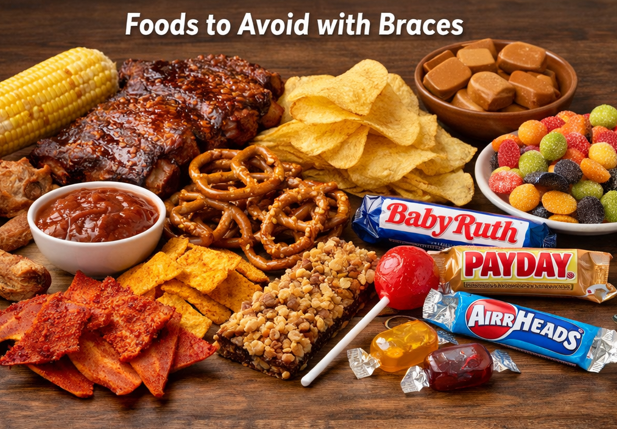
Before reviewing the chart, remember the three key decision rules. If it is soft, cooked, thinly sliced, or melts easily, it is usually safe. If it is hard, sticky, dense, crunchy, or requires biting and tearing with the front teeth, it is risky. Many foods move from the “Cannot Eat” column into the “Can Eat” column simply by cutting them into small bite-sized pieces or cooking them until soft.
| Category | Can Eat | Cannot Eat | Can Eat If Adjustments Are Made |
| Dairy | Yogurt, Greek yogurt, drinkable yogurt, cottage cheese, ricotta, shredded cheese, sliced cheese, string cheese, cream cheese, soft mozzarella, milk, chocolate milk, smoothies with dairy, pudding, custard, flan, soft ice cream without hard mix ins | Ice cream with hard candy or large nuts mixed in | Ice cream eaten with a spoon and allowed to soften slightly before eating |
| Vegetables | Mashed potatoes, baked potatoes without crispy skin, spaghetti squash, butternut squash, acorn squash, zucchini, yellow squash, cooked carrots, steamed broccoli, steamed cauliflower, cooked green beans, sautéed spinach, cooked asparagus, roasted eggplant, sweet potatoes, mashed sweet potatoes, avocado, cooked peas, soft cooked mushrooms, cooked bell peppers | Raw carrots, raw celery, raw broccoli stems, corn on the cob, hard raw vegetables | Corn cut off the cob, raw vegetables finely chopped or steamed until soft |
| Fruits | Bananas, grapes, blueberries, raspberries, sliced strawberries, applesauce, mango slices, kiwi slices, watermelon cubes without rind, cantaloupe cubes, honeydew cubes, canned peaches, canned pears, soft ripe papaya, soft plums | Whole apples, whole pears, biting directly into peaches or nectarines | Cut all fruit into bite sized pieces including apples, pears, peaches, nectarines, and firm fruits before eating |
| Meats & Protein | Thinly cut chicken breast, shredded chicken, rotisserie chicken without skin, meatballs, ground beef, ground turkey, ground chicken, fish, salmon, tilapia, cod, tuna salad, egg salad, scrambled eggs, omelets, tofu, soft beans, lentils, chili without tough meat, pulled pork that is tender, soft turkey slices | Fried chicken on the bone, ribs, tough steak, jerky sticks, Slim Jim style meat sticks | Cut meat off the bone before eating, slice steak into very small pieces, cut jerky into small pieces and chew slowly |
| Carbohydrates & Grains | Pasta of all types, macaroni and cheese, rice, risotto, quinoa, couscous, soft sandwich bread, white bread, wheat bread, tortillas, pancakes, waffles, French toast, soft dinner rolls, muffins without nuts, oatmeal, cream of wheat, grits | Hard pretzels, thick crusty bread, hoagie or sub rolls, dense artisan bread with hard crust | Use regular sandwich bread instead of sub bread, remove hard crust, tear into small pieces |
| Common Snacks & Desserts | Cheetos, cheese puff balls, Goldfish, Cheese Its, Pringles, Ritz crackers, graham crackers softened in milk, soft cookies without nuts, brownies, cupcakes, plain chocolate, Kit Kat broken into small pieces, Reese Cups, Crunch Bar in small bites, Mr Goodbar in small bites, Krackel Bar, marshmallows in moderation, pudding cups, applesauce cups | Granola, peanut butter filled pretzels, Doritos, kettle chips, popcorn, hard tortilla chips, caramel candy, taffy, Laffy Taffy, Airheads, Baby Ruth, Butterfinger, PayDay, Jolly Rancher, lollipops, hard gummy candies | Soft cinnamon rolls cut into small pieces, Cinnabon cut into small bites, thin tortilla chips eaten carefully with back teeth, pretzel sticks instead of hard twisted pretzels |
What Can You Not Eat With Braces
The clearest answer for what can you not eat with braces is to avoid hard, sticky, and tear type foods.
Sticky foods like caramel and taffy adhere to brackets and are difficult to clean. Hard foods like ice, nuts, and thick kettle chips can fracture enamel or break off brackets. Biting into foods such as whole apples and thick hoagie sandwiches create excessive force on the brackets.
The American Association of Orthodontists echoes similar recommendations for preventing braces from breakage..
The First Week After Getting Braces
Many families specifically search for what to eat the first day of braces. Teeth are often tender for three to five days. During this time, softer foods like yogurt, mashed potatoes, pasta, smoothies, scrambled eggs, and soup are ideal.
Soreness is a normal biological response to tooth movement and the initial discomfort typically resolves within 5-7 days as tissues adapt. Your regular adjustments will not cause much discomfort so normal food on the approved eating list will be absolutely fine!
Clear Braces and Invisalign
If you are considering Invisalign, the rules differ slightly. Aligners are removed while eating, which means dietary restrictions are fewer. However, you will likely have Attachments that will require some food restrictions, too.
Local Perspective for Fort Lauderdale Families
At Freeman Orthodontics in Fort Lauderdale, we see families from all across South Florida, which means beach days, school events, and restaurant outings. Braces should not eliminate social enjoyment. They simply require awareness.
If you are researching braces Fort Lauderdale or orthodontics Fort Lauderdale, we encourage choosing a practice that provides clear written guidelines and ongoing support.
You can explore more about our approach at FreemanOrtho.com
Frequently Asked Questions
What candy can you eat with braces
Chocolate that melts and does not contain sticky caramel or large hard nuts is typically safe in moderation. Examples include plain chocolate bars broken into small pieces and peanut butter cups. Avoid taffy, caramel, and hard candies.
What chips can you eat with braces
Chips that dissolve easily and are not extremely hard are generally safer. Pringles are often easier on brackets than kettle chips. Always chew slowly and use back teeth.
Can you eat popcorn with braces
Popcorn is not recommended because kernels can lodge under wires and unpopped pieces can break brackets. The bands that wrap around your molars act like a “slip & slide” that allows the kernel shells to slide below the gums causing severe infections.
Can you eat pizza with braces
Yes, but avoid extremely hard crusts. Cutting slices into smaller pieces reduces stress on front brackets.
What happens if you break a bracket
Contact your orthodontist. Avoid chewing on that side until it is repaired. Prompt repair helps prevent treatment delays.
How long do food restrictions last
Food awareness lasts throughout treatment. Most soreness improves within one week of placement or adjustments.